
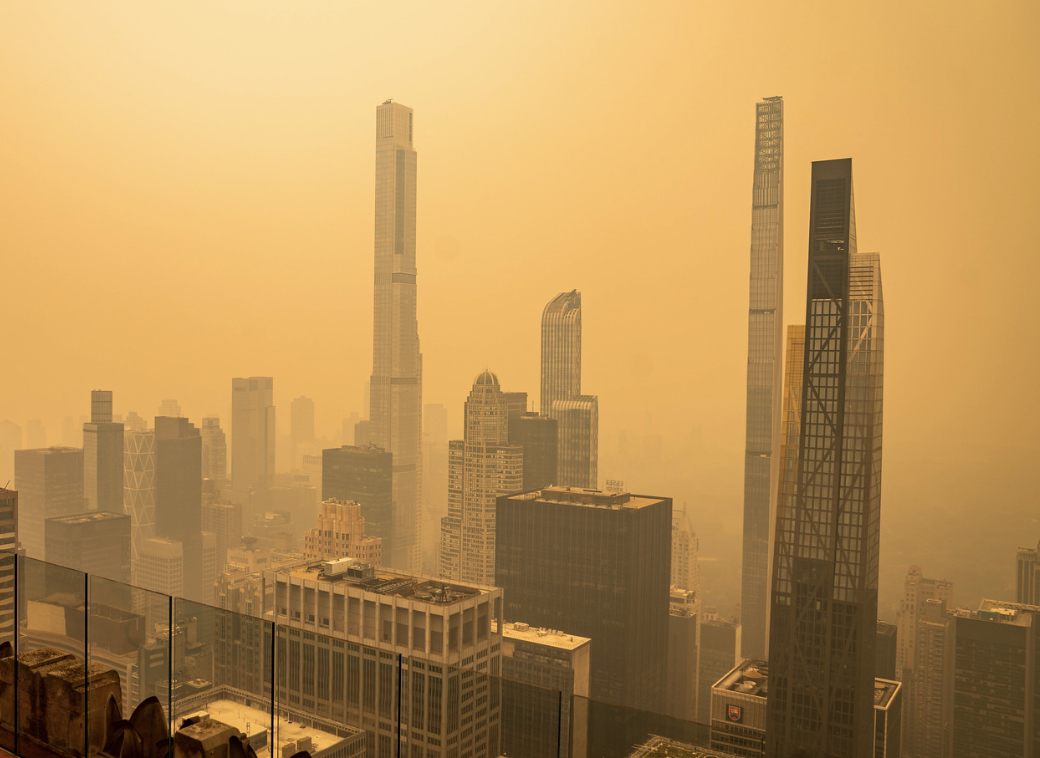
The surreal conditions caused by the Canadian wildfires over the Northeast U.S. recently struck a powerful chord not only with those directly affected but with millions who witnessed a gleaming metropolis like New York City transform into one of the world’s most polluted cities for a single day.
Indeed, in terms of air quality, what we saw in New York and elsewhere on the United States’ eastern seaboard is a daily reality in places like Chad, Iraq, Pakistan, and Bangladesh. But the impact of the images of an orange-hued hellscape in America could prove to be a tipping point for climate skeptics and the slow-to-act to better appreciate how fragile our planet is. Wildfires, extreme weather, and other devastating calamities confront us all and require our urgent, collective attention.
I believe the global faith community has an important role to play in the fight to reverse climate change. Together, we represent billions of believers. Just as Muslims, Jews, Christians, and other great faiths have increasingly found common ground on issues of justice, inclusion, and peace, we can help establish a consensus for action on climate change. Nothing better represents our shared values than our stewardship of the planet we all share.
For one, we can better use our pulpits to educate the faithful on the science behind climate change and our collective responsibility to conserve resources, reduce our carbon footprint, and protect our habitat. Some might say science and faith are incompatible. They are not. In Islam, as with other great faiths, the pursuit of scientific knowledge strengthens the faith of the believer. Science helps us understand our physical world, while faith helps us understand our spiritual obligations and gives us a moral perspective on our creations and our behavior. We need both to avert climate disaster.
The faith community can lead by example, transitioning our mosques, temples, and churches to use solar energy, for example. We can also help the faithful “solarize” the communities where they live, work, and pray.
We have all heard of “faith-based” investors who choose investments that align with their beliefs. Houses of worship also raise resources to serve their congregations through voluntary contributions, variously called tithes (Christianity), zakat (Islam), gurudeva (Hinduism), and ma’aser kesafim (Judaism). These investments and offerings can and should be encouraged and directed to benefit sustainability initiatives.
Houses of worship are often the physical as well as the spiritual anchors of our communities. This gives the world a ready-made infrastructure for community-based climate action, providing not only moral guidance on sustainability, but information, materials, and other tools to effect and amplify meaningful action. UK-based Tearfund, supported by the Church of England, is one of several organizations that provide “climate emergency toolkits” that allow houses of worship and other community-based organizations to respond to the climate crisis.
The scientists have done their job raising the alarm. The diplomats have done their job rallying their nations to commit to carbon reduction targets. Businesses are starting to do their job by adopting new social responsibility initiatives that promote sustainability. It’s time for the global faith community to really step up. Together, the world’s believers can do amazing things to build a global, grassroots consensus on the biggest moral issue of the day and to act on it at a mass scale. Reversing climate change will require unprecedented coordination. It will require millions of daily acts. It will require both clear science and a clear conscience.
Earlier this week, I gave an address at the United Nations to hundreds of faith leaders, diplomats urging coordinated action on climate. Recently, I have met privately with leaders such as His Holiness Pope Francis, Martin Luther King III, and Chief Rabbi of England Ephraim Mirvis. I can tell you that the religious counteroffensive against carbon is underway. We are fully committed to standing beside the major industrial nations at the G20 to help them achieve their ambitious reduction targets. We stand with the full community of nations to fight for climate justice in which the poor do not bear the brunt of ecological damage. We stand with the scientists, the NGOs, and the companies, representing and rallying the billions of the world’s faithful to this momentous, singular cause.
The climate crisis is no longer distant or abstract. It is no longer a Cassandra-like fantasy of doom. We’ve seen the future with our own eyes, and we will need the hearts of the faithful to avert it.