

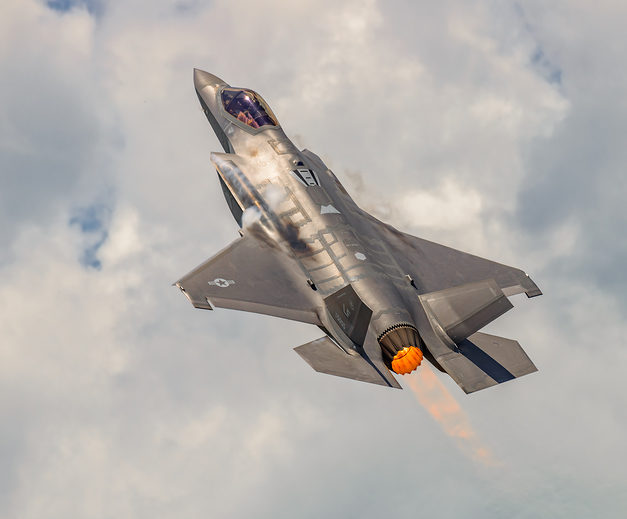
In late December, a video of a fighter jet crash-landing at an airbase in Texas made the rounds in the news and on social media. Video shot by a bystander showed the aircraft tipping over as it touched down, then sliding nose-first across the runway as the pilot ejected.
The plane in the video was none other than an F-35 – a fighter that was once billed as the future of American air power but may now be the defense industry’s costliest mistake. As of last April, projections for the total lifetime cost of the F-35 program had reached $1.7 trillion, even as new delays and problems continued to come up.
2022 was a hard year for the F-35’s credibility. Reports emerged that the Pentagon was redacting parts of its annual report on the F-35. The pretense was that the reports contained sensitive information, even though the data from previous years had been available to the public. However, several members of the House Oversight Committee exposed it wasn’t the fighter’s cybersecurity or radar technologies that the Pentagon sought to hide; it was embarrassing evidence of software glitches and a lack of spare parts.
In the fall of 2022, the Department of Defense discovered F-35 maker Lockheed-Martin’s subcontractor used Chinese metal alloys in a batch of planes even though federal procurement laws ban the use of materials produced by that country. The Pentagon’s initial hold on new deliveries didn’t last long; within a month, the agency waived official policy to allow production of the aircraft to continue despite the discovery of Chinese-origin materials in its single, often unreliable engine.
Even 20-plus years past its launch date, officials are playing a desperate game of whack-a-mole against anything that might cause bad publicity or undercut the fiction that the F-35 fleet is in fighting shape. And they are enabling shady behavior from the aircraft’s manufacturer, Lockheed-Martin, to keep up appearances.
That reflects the long-time mindset behind the F-35 project: Get the planes on the assembly line and paper over the problems with taxpayer dollars. But it is not working, and aircraft continue to either languish on the ground or fall out of the sky.
The F-35’s entire history is filled with incidents like these. However, it is the enduring, systemic failures that are really responsible for the program’s disastrous state. The worst of these was Lockheed-Martin’s decision to start production while problems were still being addressed. When those problems piled up and the company started facing ballooning costs and missed deadlines, it started pushing back fixes in order to meet production timetables. As a result, the company wasn’t just making changes to the F-35 mid-production – it was delivering non-functioning aircraft to the military and only then making what often ended up being major overhauls. And of course, the American taxpayer has been paying for every new round of redesigns.
Some argue the massive investment of taxpayer money and American production capacity means we should continue the F-35 program. But great leaders know that the sunk cost fallacy is the path to failure – a better one is to end the program now, establish processes and metrics of success based upon military goals, and build the next plane based around those processes and goals.
Great leaders also admit fault. It is easy to point at Lockheed-Martin and its subcontractors for many structural failures. But it is elected officials, military leaders, and political appointees who are really at fault – the contractors are simply following the money.
As is the case with many things in America today, we have burned through billions of taxpayer dollars only to make the problem worse. And while the original Lockheed company once exemplified American innovation, creating aircraft that streaked across the sky at record speeds and record heights, the defense giant today has left American air power crashing and burning. Our leaders must fix this by starting over.