
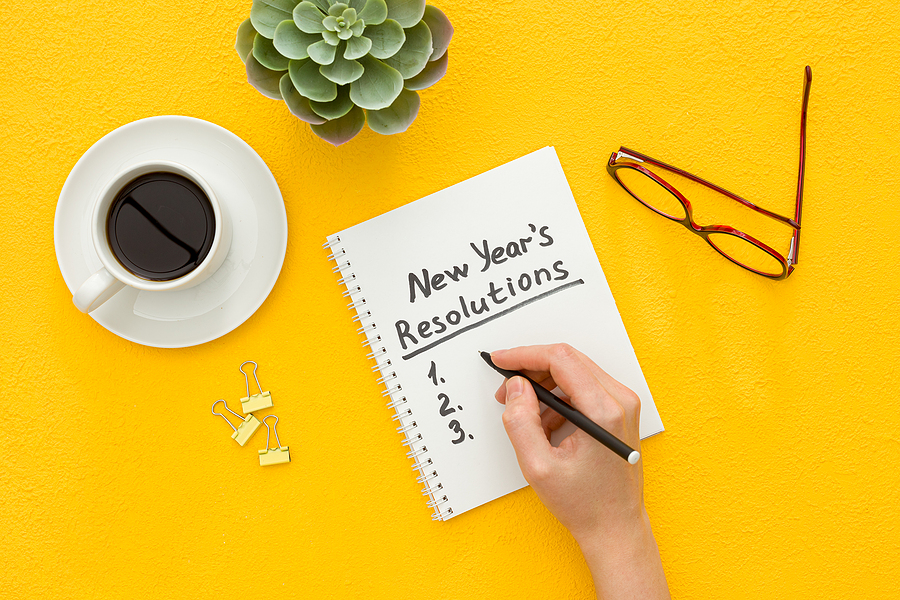
Even though our New Year’s Resolutions have a high failure rate—AI reports as high as 80 to 90 percent—I take them seriously. It’s a moment in the year when I have a chance to look back and look forward and ask myself, “What can I tweak that would make me better?”
Before writing this year’s resolution, I reviewed my past goals to see how I’ve done, and I discovered it’s a mixed bag.
Five years ago, my resolution to purge, clean, and live a “less is more” philosophy had moments of success, but we’d have to overlook the number of shoes in my closet.
The following year, my goal was to stop being a “doing machine” and relax more. I knew I wouldn’t be a yogi, but could I kick up my legs on the sofa, watch or read something, and ignore my to-do list? I can report that I use a smaller index card for my to-do list, which sits in my back pocket—so maybe there’s small progress.
The next year, I thought about the need to be bold as I prepared to launch my first novel. Having published two more novels, it’s fair to say I’ve made solid progress on my boldness. Life is too short to be wimpy.
The following year, I was focused on “creating space,” the most meaningful aspect being the space for others to be who they are and share their thoughts, as I listened really hard to understand. This is an ongoing goal that I’m conscious of, and I think I am a better listener. On good days, I even understand what I hear.
Last year, I crafted a resolution that was totally me: lead with positivity. I was born preternaturally positive, but a dark world—like the one we’re living in—can challenge anyone’s mood. The trick here is to be positive without being dismissive, which means providing reasons and a rationale. I often fall back on history… how many times has our country felt challenged and its people dispirited, yet we persevered and turned the corner? Also, are there areas where, as individuals, we can make a small positive difference?
If a mood of negativity remains, I might recall Winston Churchill, who famously said, “If you’re going through hell, keep going.” When positivity fails, humor is a good salve.
Sharing the history of my resolutions sets the stage for this year’s unusual one, which surprised even me:
Make AI your friend, not your foe.
At the ripe age of 68, I seldom run to embrace a new technology—especially one that has taken the jobs of writers, engineers, illustrators, and more. I’ve treated AI a bit like Lord Voldemort in Harry Potter: He who shall not be named.
But is that right? Am I doing myself a disservice?
I’ve read too many pieces in which writers bemoan another job being taken from them by AI. A former client, who used to pay me well to write case studies, told me last year that they no longer need writers to do the work.
“AI does a good enough job—not as good—but so much cheaper that we’re fine.”
Fortunately, I’ve shifted gears, but so many colleagues have been affected by the seismic change brought on by AI. I feel bad for my peers and have said a firm “no” to AI.
Now I’m seeing it differently. AI can be an independent judge of my work, just as my readers are. AI can help create images, speed up lots of tasks, and listen to my voice tracks. I can like or dislike what it gives me, but it will be something new to consider.
I know too many people, including my husband, whose work is far more technical, who are benefiting from AI. It is time for me to give AI a try, without letting it replace my skills. AI won’t do my writing, but it might add a new perspective.
As I prepared to write this column, I remembered my grandmother, who came from Eastern Europe and helped my family in so many ways, especially in the kitchen. When the moment came that we bought a dishwasher, she was furious. She worried she had lost her job. Of course, she hadn’t. Her job had just changed.
Every generation struggles with new technologies, but those with open minds do best.
Let that be me in 2026.