

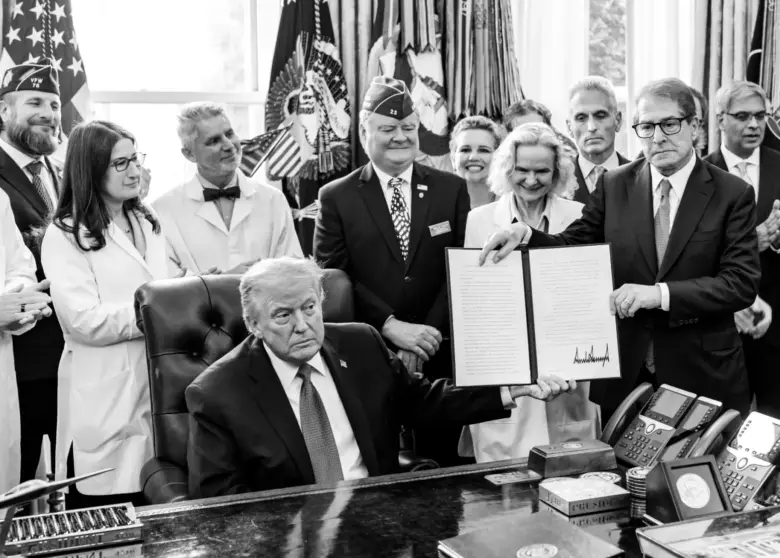
The photo from last month’s Oval Office signing is everywhere: President Donald Trump at the Resolute Desk, pen in hand, declaring that cannabis should move from Schedule I to Schedule III. It’s being sold as the end of an era—as if the War on Weed just wrapped with a neat executive-order bow.
It didn’t.
By directing the feds to reclassify cannabis, Trump is finally admitting what patients, doctors and voters have been saying for decades: Cannabis has medical value and never belonged in the same legal bucket as heroin and LSD. (I said as much in my 2018 TEDx Talk.) That alone is historic, and the largest drug policy shift of our lifetimes. Schedule III status will ease research barriers, loosen some regulatory handcuffs and, crucially, pave the way to end a uniquely punishing tax treatment for state-legal cannabis businesses.
But roughly 30,000 people in the U.S. are still incarcerated for cannabis. Many more carry the lasting damage of a past conviction: jobs lost, housing denied, opportunities foreclosed. Even in 2024, law enforcement made more than 200,000 cannabis arrests nationwide, per FBI data. And as the ACLU has documented for years, Black Americans are still several times more likely to be arrested for cannabis than white Americans, despite similar rates of use.
So yes, Schedule III ends one front of this war: the farce that cannabis has “no accepted medical use.” It does nothing about the other front—the one about cages and lifelong collateral damage. If cannabis is now officially medicine under federal law, it is morally indefensible to keep people locked up for possessing, growing or selling that same plant.
We’ve already seen what real urgency can look like. In his final year, President Biden commuted the sentences of nearly 2,500 people serving time for nonviolent drug offenses—a sweeping act of clemency. Trump’s executive action could be the start of a similar reckoning focused on cannabis. Instead of stopping at a scheduling change, the administration and Congress should be talking about:
- The mass review and release of nonviolent federal marijuana prisoners;
- The automatic expungement of past federal cannabis convictions, with incentives for states to follow;
- And ending collateral consequences that treat an old pot charge like a permanent stain on a person’s right to housing, employment, parenting and citizenship.
Beyond cannabis, we need to stop pretending criminalization is a rational response to drug use at all. Fifty years of arrests and incarceration didn’t solve substance use; they helped fuel a sprawling carceral system and a fentanyl epidemic.
Drug use is a public-health issue. It always should have been handled as such.
Meanwhile, the legal cannabis industry keeps growing. More than 40 states now have some form of legal marijuana. Billions of dollars flow through regulated dispensaries, while in the same zip code someone is still behind bars over a small grow or a low-level sale.
That dissonance is the “next war on cannabis.” It’s being fought with bureaucratic indifference.
So by all means, let’s recognize the significance of this historic move. Schedule III is overdue, and it will matter for patients, researchers and businesses that have shouldered an absurd tax burden for too long. But we cannot let a single Oval Office photo op stand in for justice.
If this rescheduling is to mean anything, it must be the beginning of a second wave of reform, not the end of the story. Until the last nonviolent cannabis prisoner is free—and until a weed charge no longer shadows a person’s life—the war on pot isn’t over. It’s just wearing a better suit.