

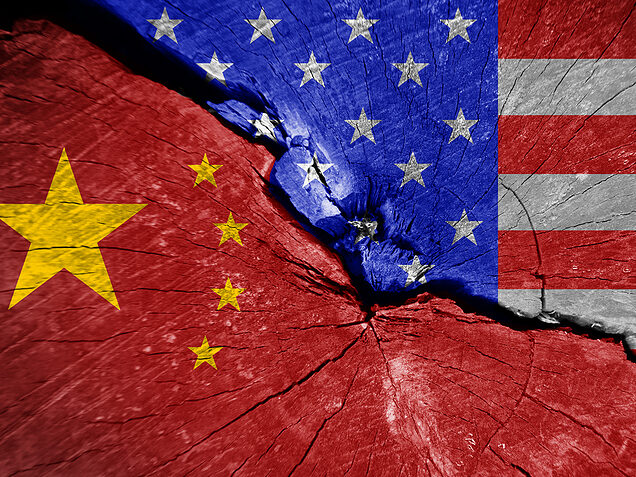
Economic coercion has become an integral part of China’s foreign policy. Countries that dare to interact with Taiwan, support democracy in Hong Kong, oppose genocide against the Uyghurs, or offend any other of Beijing’s so-called core interests face sanctions and embargoes. Since 2008, 17 countries and more than 123 corporations have lost tens of billions of dollars due to China’s weaponization of trade.
From Beijing’s perspective, such coercion works. After a Chinese ban on Norwegian salmon imports in 2010, Norway’s leaders refused to meet with the Dalai Lama when he visited the country in 2015. Following sanctions against South Korea’s Lotte Corp. in 2016 and embargoes of German pork four years later, the governments of both countries remained silent when China passed a law suppressing democracy in Hong Kong in 2020. Even Hollywood studios now avoid producing films that cast China in a negative light.
Few, if any, countries can afford to truly decouple from one of the largest economies in the world. So the United States and its like-minded partners need a new strategy to stop Beijing’s bullying: “collective resilience.”
Most targets of Chinese economic coercion depend more on trade with it than it does on them. Reliance is not a one-way street, however. China relies on Japan, for example, for 90 percent of the silver powder it uses to make solar panels. In some cases, China could make up for a loss of critical imports by producing them domestically, but with a significant cost. Indeed, the 17 countries targeted by Chinese economic coercion collectively sell China more than $40 billion in goods on which it is more than 70 percent dependent.
Therein lies its leverage. Trying to take a solitary stand against China would be foolhardy, but joining together in a collective economic defense framework could well threaten enough inconvenience that it might deter Beijing from predatory behavior.
The Biden administration deserves praise for the steps it has taken thus far. Washington has encouraged its friends to diversify their trade to protect themselves from potential Chinese tariffs and embargoes. This approach has paid off: In 2020, China slapped tariffs on Australian barley, wine and beef to punish Canberra for pushing for an inquiry into the origins of COVID-19. Thanks to its diversification efforts, however, Australia was able to redirect these goods to the rest of the world.
The United States has also worked with its partners to develop networks for “reshoring” and “friend-shoring” — moving key elements of production chains to safer locations. Launched in June 2022, the Minerals Security Partnership aims at reinforcing supply chains for critical materials such as nickel, lithium and cobalt.
More recently, the United States, Japan, South Korea and Taiwan formed a “Chip 4” alliance to consolidate their semiconductor supply chains. Such efforts raise costs and lower efficiency but also protect against China’s predation.
Yet, these measures are reactive and don’t deter China’s overall practice of economic coercion. That’s where collective resilience would come in.
Building the will to support such a strategy won’t be easy. Smaller states will worry that China will target them, and businesses may balk. The United States should work through the G-7 and Australia. These countries share the motivation to counter China: They recognize that their self-interest lies with the liberal order, they’re all medium-to-large players that can’t be easily picked off, and they can leverage China’s vulnerability.
Together, they export more than 400 items on which China is 70 percent dependent, with a trade value of $24.9 billion, and almost 160 items, valued at $7.8 billion, on which China is 90 percent dependent. By working together, they could threaten to sanction some of China’s high-dependence items should it attempt to coerce any of their members. The goal isn’t to impose punishment — no one should want a trade war — but to use the credible threat of punishment to prevent China’s bad behavior.
Some critics might find such a strategy anathema to the liberal order it is meant to protect. They should remember that high-stakes competition against another great power is sometimes dirty. During the Cold War, the United States sometimes countenanced illiberal practices by its allies. With luck, however, the threat of collective economic reprisals will never be acted on. In that sense, the strategy resembles nuclear deterrence. And like that strategy, it will require the capabilities and the will of all involved to signal to China that it can no longer use economic coercion to threaten the liberal international order.