

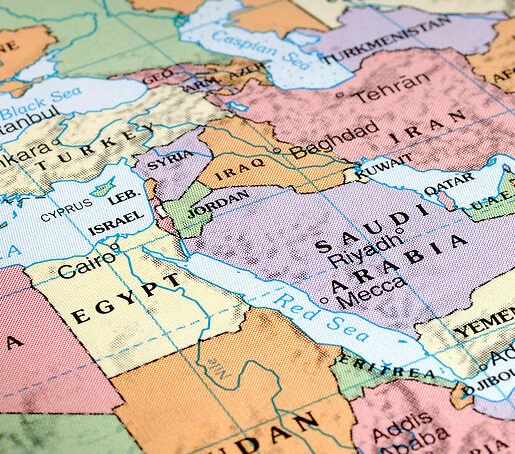
Gulf stock markets rallied in September, following the Federal Reserve’s rate cut and renewed optimism that further rate cuts were to come. Behind the cheer lies a more complicated reality: debt issuance across the Middle East — sovereign, corporate and family-owned — is being delayed, restructured or burdened by high U.S.-imported borrowing costs.
The region is waiting for cheaper capital that has not materialized. Because most Gulf currencies are pegged to the U.S. dollar, local central banks have little choice but to follow the Fed’s timetable rather than their own.
Still, the Gulf’s debt markets remain resilient. Gulf Cooperation Council issuers accounted for 35 percent of emerging-market dollar-denominated debt issuance in the first half of 2025, with $1 trillion outstanding in the region. Saudi Arabia issued nearly $48 billion in bonds and sukuk (Sharia-compliant financial certificates that serve as Islamic alternatives to conventional bonds) during the period, despite a 20 percent year-on-year decline in volumes.
This reflects a key strength of the dollar peg: it provides credibility and predictability. Investors can confidently commit capital to Gulf issuers knowing exchange-rate risk is minimized. That stability helps explain why, even amid high U.S. rates, demand for Gulf debt has stayed strong.
The same peg also imports U.S. policy. Borrowers across the region are stuck with rates set in Washington, even when local inflation is modest and energy revenues are robust. That creates a mismatch between domestic fundamentals and financing costs.
The challenge today is not only economic but political. In the early months of President Trump’s second term, the administration’s “America First” approach has heightened uncertainty around U.S. economic policy. At a minimum, this has created a degree of paralysis at the Federal Reserve, as officials navigate sharper political scrutiny and learn in real time the potential effects of American tariffs. At a maximum, it has injected overt politics into the debate over how much and how quickly to cut interest rates.
For Gulf governments and corporations, the issue is less about questioning the peg itself than managing the costs of its consequences. The peg still serves as an anchor of market stability. It also means the region cannot set its own rhythm on interest rates.
Consider a hypothetical Gulf family group with multiple portfolio companies. Its retail arm is weighing whether to refinance a loan at 9 percent now or hold off, hoping for cheaper funding later that may never come. Its construction subsidiary needs project financing but fears profitability will erode under today’s rates. Its logistics business wants to issue a sukuk to expand capacity, but risks overpaying if the Fed cuts rates in the near term. At the group level, executives debate whether to consolidate, stagger maturities or inject equity — all imperfect choices shaped by Fed policy far from home.
Borrowers across the region are not standing still. In Riyadh, Dubai and Doha, treasurers are quietly reshaping the way they issue debt to account for prolonged uncertainty. One approach is to build in resettable coupons that can step down if benchmark rates fall, allowing issuers to capture savings without a costly refinancing. Others are experimenting with staggered issuance strategies — raising short-term funds now while leaving longer-dated maturities for a more favorable environment. For some, callable or puttable structures have become standard, providing an exit route if conditions shift.
The region’s sovereign wealth funds are also playing a more prominent role, acting as stabilizers when market conditions are unfavorable. By anchoring deals or providing bridge financing, they help issuers avoid being locked into punitive coupons while still keeping projects on track. These techniques do not eliminate the reality of imported U.S. monetary policy. Still, they do soften its bite and allow capital programs to proceed in measured steps rather than halt entirely.
The bigger lesson is that Gulf and wider Middle Eastern debt markets are learning to live with volatility. For borrowers, the discipline is in resisting the temptation to lock in long-term financing at the top of the rate cycle, and instead designing capital structures that preserve flexibility. For investors, the message is to expect a surge of pent-up issuance once the predicted series of Fed cuts finally arrives — likely clustering now as we enter late 2025 and or coming early 2026 — and to prepare for spreads that could tighten quickly as regional demand collides with limited issuance windows. For policymakers, the task is to preserve the advantages of the dollar peg — its credibility and predictability — while complementing it with liquidity tools and transparent signalling that reassure markets even when U.S. decisions diverge from local needs.
The Gulf’s dollar peg continues to provide the region with stability, credibility and investor confidence. It also imports interest-rate cycles that do not always fit local conditions. Borrowers are adapting, with flexible structuring and patient capital strategies, while investors continue to view the region as a reliable destination.
For now, Middle Eastern debt markets remain caught between resilience and restraint — waiting on Washington’s timing but determined to continue building even when the clock is not in their own hands.