

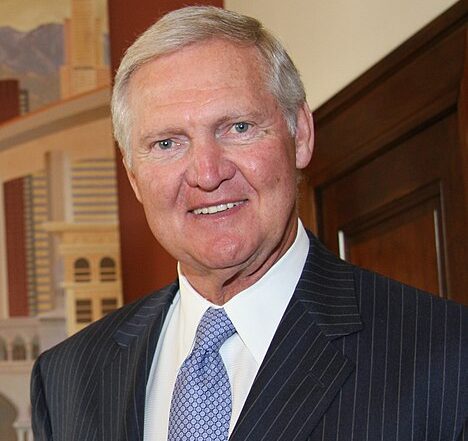
Hollywood is where they use you and then throw you away — and not just in the movies. If there was ever verifiable proof of that dictum, it came with the recent death of Jerry West, one of the greatest players in basketball history.
His death was announced by the Los Angeles Clippers rather than the Los Angeles Lakers, for whom he played his entire professional career of 15 years and spent an additional three years as a coach and 14 as a front office executive. The Lakers’ treatment of West is the consummate example of a professional sports team demonstrating ingratitude, what Shakespeare aptly called “the marble-hearted fiend.”
That West wound up in Tinseltown is a Hollywood story. Born in a small rural West Virginia coal mining town, he was a basketball prodigy, the greatest shooter of his generation with a superb all-around game. Despite being named 1959 NCAA tournament MVP, he and his West Virginia team lost the championship game by one point — a foreshadowing of future professional disappointment. In 1960, he and friendly rival Oscar Robertson were the nucleus of the most dominant amateur U.S. Olympic team ever, winning the gold medal handily. (Michael Jordan’s similarly dominant Dream Team were professionals.)
Drafted by the Lakers when the franchise transferred from Minneapolis to L.A., West led the team to the NBA Finals nine times — where they lost eight, often in heartbreaking final games. His performance was invariably superlative, but Sisyphean. Owing to his heroic but usually failed efforts, he became known as “Mr. Clutch. But the Boston Celtics, New York Knicks and Milwaukee Bucks had his number.
Finally, in 1972, he and Wilt Chamberlain teamed up to form one of the great NBA teams in league history. The Lakers won 33 consecutive games, still a record, and he earned his only NBA championship. The NBA made his silhouette the iconic NBA logo, one of the most recognizable images in sports. He received no money and never complained.
In sports, Hall of Fame players who transition to manager or coach are often unable to translate their personal success on the field to the teams they helm. When West was named Lakers’ coach after retiring, the team had a winning record every season — despite not having Jerry West playing for them. He was later tabbed to be general manager and was instrumental in continuing the franchise’s winning tradition by constructing the Showtime Lakers of the 1980s, featuring Magic Johnson and Kareem Abdul-Jabbar, a team that won five NBA titles.
West was later responsible for obtaining the rights to Kobe Bryant out of high school, signing Shaquille O’Neal, and hiring Phil Jackson to coach the great Lakers teams of the early 21st century that won five more NBA titles. In his 60-year basketball career, West was the consummate gentleman and was awarded the Presidential Medal of Freedom in 2019. Never a hint of scandal attached.
How did the Lakers repay West? After Phil Jackson was hired, he once unceremoniously kicked his boss — West — out of the locker room in front of the team. Soon after West burned out mentally, the Lakers parted company with him. Controlling owner Jeannie Buss was asked to name the five greatest Lakers, and she made a point of leaving West off the list, which was ridiculous. Instead, she named LeBron James, who had spent only four up-and-down seasons with the team.
But the coup de grace was the portrayal of West as a loud, alcoholic executive in the 2022 HBO docudrama “Winning Time: The Rise of the Lakers Dynasty.” In one apocryphal scene, he tosses an NBA championship trophy through an office window. Imagine how the real West felt watching that, with painful memories of championship losses to the Celtics, hoisting championship banners with Magic Johnson, and mentoring a teenage Kobe Bryant alone in a gym for hours.
Laker legends were outraged, especially Kareem Abdul-Jabbar.
“Instead of exploring his issues with compassion as a way to better understand the man, they turn him into a Wile E. Coyote cartoon to be laughed at. … He never broke golf clubs, he didn’t throw his trophy through the window. Sure, those actions make dramatic moments, but they reek of facile exploitation of the man rather than exploration of character.”
West’s attorneys wrote the Lakers, “You replaced the real Jerry West — a consummate professional — with his polar opposite, then portrayed this lie to the public as genuine.”
Jerry West, “The Logo” — who gave much of his life, not just personal but professional, to the Lakers — helped bring members of the organization generational wealth, international fame, and untold joy to millions of fans. As a final display of ingratitude, the Lakers confiscated his lifetime season pass. If he decided to attend a Lakers game, he was forced to buy an exorbitantly priced ticket at the Staples Center — no doubt in the nosebleed section where the action was little more than a rumor.
Before his death, West told The Atlantic, “One disappointing thing (about my career) is that my relationship with the Lakers is horrible. … I still don’t know why. And at the end of the day, when I look back, I say, ‘Well, maybe I should have played somewhere else instead of with the Lakers, where someone would have at least appreciated how much you give, how much you cared.’”
A once-famous, now-forgotten sportswriter observed, “Sports do not build character, they reveal it.”