

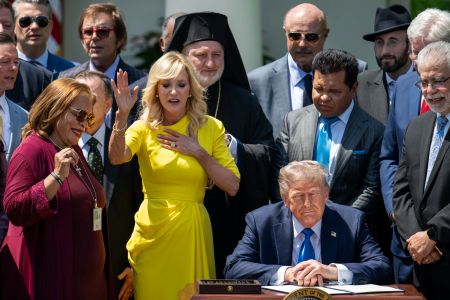
President Trump signed into law this summer a Working Families Tax Cut, one of the most pro-growth and pro-family pieces of legislation in recent years. This tax relief bill includes a generous child tax credit and prevents the federal government from subsidizing Planned Parenthood through Medicaid payments.
This victory is the latest proof point of what happens when pro-family voters mobilize and make their voices heard. In last year’s elections, faith voters were decisive in securing the electoral votes needed to win the presidential election. With important gubernatorial races taking place this fall and harbinger midterm elections on the horizon, Christian voters of every stripe and denomination will need to come together and make our collective voices heard if we want to protect recent gains and build on these policy wins.
As the CEO for the Faith and Freedom Coalition, one of the ways that I will be doing this is by building on the emerging coalition of Catholics and evangelical Christians who are eager to roll up their sleeves to influence elections and policy outcomes.
One of the most encouraging trends is seeing the diversity of the coalition. At a recent conference, Latino, Black and Asian attendees met with lawmakers and clergy to educate themselves on the issues and commit to mobilizing in this year’s election and beyond.
Whatever theological differences we may have pale in comparison to what we are up against.
Some want to erase gender differences and encourage irreversible child mutilation. Antisemitism is being more widely accepted in some circles, and self-described socialists are openly running for office.
Unfortunately, Trump and congressional Republicans are facing a challenging political environment in 2026. Since World War II, the president’s party has lost an average of 26 seats in the House of Representatives and four seats in the Senate. Only once since 1900 has the president’s party won seats in both chambers in a midterm election.
If the president loses control of Congress, Trump will find it incredibly difficult, if not impossible, to continue building his legislative agenda. Under Democratic control, lawmakers will work to undo as many of Trump’s legislative victories while gumming up the works to prevent any of his priorities, including judicial nominees.
At the state level, Democratic politicians will resist efforts to expand school choice, extend religious freedom protections, and allow families to keep more of their hard-earned money.
To some, this may sound like scaremongering. The reality is that Christians are swimming upstream.
Academia, Hollywood and the legacy media remain powerful forces dictating what is mainstream and what is “radical.” One of the ways this is being done is by throwing around the term “Christian nationalism” to marginalize and dismiss people of faith.
Whatever our theological differences, Protestants and Catholics are rooted in biblical values. We prioritize the nuclear family, the dignity of work, and the sanctity of life. Our faith is central to our identity and our outlook on work, education, family, and, yes, public policy.
By uniting under these shared principles, we can counter the cultural tide and reclaim ground in the public square. We’re not erasing our differences but channeling them into a common purpose: defending life from conception to natural death, supporting policies that strengthen marriage and family, and ensuring religious liberties are protected against encroaching secularism.
If millions of Catholic and evangelical voters register, turn out to vote and advocate together in battleground states, this coalition could tip the scales in gubernatorial races and secure congressional majorities. We’ve seen it before — faith voters flipped key seats in 2024 and could do it again with the 2026 midterms looming.
Together, we can extend Trump’s pro-family legacy, fostering a nation where faith flourishes and families thrive.