

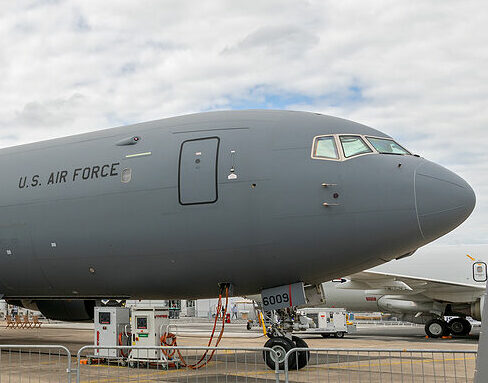
The Air Force refueling tanker is a critical aircraft for the armed forces, and it’s also flown by our allies. Its primary purpose is to deliver in-flight refueling for fighter/bomber jets and cargo planes, close to the fight, and for trans-oceanic military supply and humanitarian missions. “Close to the Fight” means the KC-46 Pegasus enables the receivers to fly to-from their refueling rendezvous. This makes it possible for crews to perform longer, more complex missions with more time on target vs. time and fuel consumed by having to fly greater distances to fewer tankers.
Since the 1950s, the Air Force has relied on the KC-135 Stratotanker for refueling missions. But over the past several years, the Air Force has embarked on a modernization program to revitalize its tanker fleet. The first phase includes the introduction of the KC-46, a 767 derivative multi-purpose tanker designed to adapt to changing technologies and serve as a communications center for U.S. and allied aircraft during missions, and simultaneously provide cargo carrying and medical capabilities.
The Air Force is entering the second phase of its tanker revitalization plan. Congress is considering whether to introduce another aircraft into the U.S. tanker fleet. Initiating a military program competition requires due diligence to be performed during the decision process, and that is particularly true considering the amount of money it takes to adopt and sustain a new military platform. As acquisition discussions begin on Capitol Hill, Congress should ask the questions necessary to make an intelligent decision. Most important, Congress must ensure the aircraft can accomplish its mission.
The KC-46 has been operational since 2019 and successfully performs more than 400 sorties per month. It can refuel most receiver aircraft in the U.S. inventory, including the F-35 and F-15 fighter jets and the P-8A reconnaissance plane used for anti-submarine missions.
The only other air refueling tanker in production today is the European-made A330 Multi Role Tanker Transport. The European tanker is not cleared to refuel many U.S. aircraft and would have to be significantly modified (at U.S. taxpayer expense) to meet the one-of-a-kind needs of the U.S. military. Due to its much larger size, its operating costs are higher, making it a more expensive and less efficient option. The A330 MRTT ground maneuvering and parking require more ramp space than a KC-46 footprint, thus limiting its flexible deployment base availability opportunities.
The strength of a military platform’s supply chain is also a critical consideration. Congress must examine the health and reliability of its production and sustainment at every level before investing billions of dollars into a decades-long program. The KC-46 is the military derivative of the proven 767 commercial jetliner. It is manufactured in the United States and has a secure and reliable international supply chain.
The A330 MRTT is the military derivative of the commercial A330, which is manufactured in France and has suppliers throughout Europe. Despite public commitments to produce a limited number of these aircraft in the United States, much of the A330 MRTT tanker’s supply chain would remain in Europe, opening it to problems such as spare parts shortages, delayed deliveries of necessary aircraft components, and international policy disputes, among other challenges. Congress would also need to pay special attention to the production timeline. Realistically, it could be a decade or longer before an A330 MRTT production line in the United States would be functional and able to deliver completed aircraft to the Air Force.
Security risks also need to be considered. The Air Force requires its tankers to be intelligence hubs for aerial missions, centralizing and dispersing data in real-time to other aircraft. Congress must demand in-depth information from A330 MRTT manufacturers and suppliers about data protection and security measures put in place to keep U.S. intelligence safe.
Military pilots and their crews need functioning aircraft that are reliable, safe and able to meet the needs of the mission. American citizens expect military platforms to protect them. Congress has an important job to do concerning authorizing and funding military programs. Concerning the future of the U.S. tanker fleet, there is a lot to consider and Congress should ask the tough questions and demand straightforward answers.