

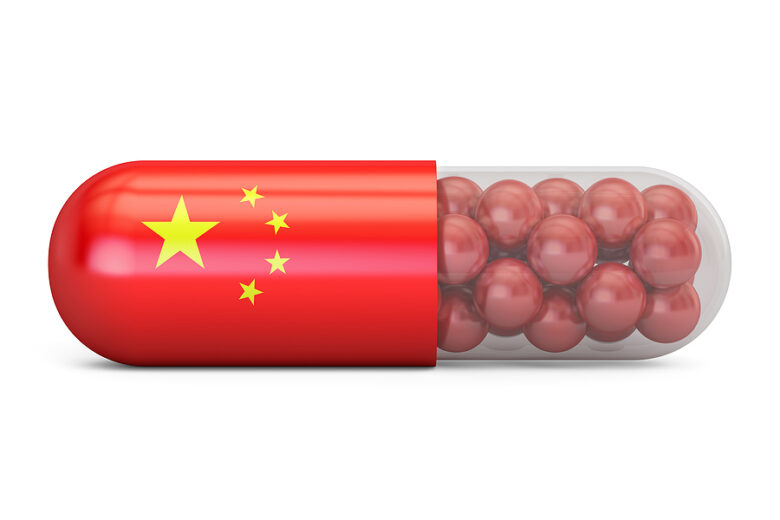
Americans spent more than $700 billion on prescription medicines last year. However, many of them remain worried about the safety of their medications.
That’s because most of America’s generic prescription drugs come from overseas factories rife with safety and quality issues. U.S. pharmaceutical companies tell us not to worry, though; they say the industry doesn’t rely on China for finished medicines.
What they aren’t mentioning is that even the developmental stages of America’s pharmaceutical supply chain are being shifted to China. And that’s putting more of America’s drug production in the hands of a global adversary.
Since 2020, U.S. pharmaceutical companies have signed $53 billion in licensing deals with Chinese biotech firms. That has led to essential research capital being diverted away from biotech hubs in America.
A decade ago, China identified the pharmaceutical industry as a strategic sector. Since then, Beijing has chosen to heavily subsidize its drug production. By funneling money directly to state-owned drug manufacturers, Beijing has accelerated China’s early stage drug development. Meantime, the United States has been hobbled by a bureaucratic system that imposes costs before drugs reach the market. As a result, clinical trials in China are now 50 percent to 100 percent faster than in the United States.
Chinese biotech companies supply one-third of all new drug compounds entering America’s pharmaceutical pipeline. That’s up from virtually zero five years ago. In fact, Chinese drug compounds are on track to reach 35 percent of FDA approvals by 2040.
This represents a massive shift in America’s pharmaceutical supply chain. Rather than merely importing finished drugs, U.S. pharmaceutical giants have decided to move future drug research and development to China. And so, the lab science, clinical trials and intellectual property of America’s medicines will soon be isolated inside China’s heavily subsidized and rapidly evolving biotech system.
Should we be concerned? Yes, because China understands that dominance over critical supply chains translates into geopolitical leverage. Consider Beijing’s increasing control over rare-earth metals. After years of subsidization and consolidation, China now controls 90 percent of global refining capacity, leaving the United States with no viable alternatives if exports are curtailed. Essentially, when substitutes don’t exist, dependence becomes coercion.
A similar vulnerability is emerging in the pharmaceutical industry. Drugs on U.S. pharmacy shelves may not bear a “Made in China” label, but China supplies 80 percent of the active pharmaceutical ingredients and precursor chemicals essential to their production. Beijing also dominates global production of many antibiotic ingredients, and produces 90 percent of the acetaminophen and 72 percent of the ibuprofen consumed in the United States — the core components of everyday medicines such as Tylenol and Advil.
Beijing knows it has created a strategic chokepoint. And Chinese state media acknowledged this during worldwide medical shortages in the early months of the COVID-19 pandemic.
China’s biopharma industry is tightly integrated with the country’s military-civilian complex, which merges commercial research and military operations. U.S. companies operating in China inevitably interact with firms identified by Congress and the Pentagon as military-linked. One example: Beijing-based WuXi AppTec has been flagged as a potential Chinese military contributor even as it develops ingredients for one-fourth of U.S. drugs.
This is now a national security issue, since Chinese pharmaceutical entities are becoming the integral first step for research into cutting-edge drug therapies. It’s all because Big Pharma has outsourced the front end of America’s pharmaceutical ecosystem to its primary strategic competitor.
It’s time for Washington to enforce guardrails on pharmaceutical licensing and investment. To make a real difference, though, Congress and the administration should start blocking federal contracts for firms linked to the Chinese government. Lawmakers should also adopt legislation to rebuild America’s domestic drug research capacity.
The United States must protect the innovation base that once underpinned its biotech leadership. Otherwise, Beijing could soon become the world’s default engine for developing and manufacturing the medicines of the future.