

The fruit doesn’t fall far from the tree, they say. More than a century ago, investigators desperately hoped that it would prove true in a big criminal case. But as we’re about to discover, things didn’t work out that way.
It all started on a Friday in late September 1898. Gunmen robbed a Missouri Pacific Railroad train’s express car near Leeds, Mo. That was where valuables were kept, and it’s believed the bad guys got away with a bundle. Some sources say the haul was about $40,000 (more than $1 million today).
The railroad bosses brought in agents from the Pinkerton National Detective Agency. It was the world’s largest private law enforcement agency at the time. Its services came with a hefty price tag, meaning the rail carrier wasn’t fooling around. It was paying big bucks, and it expected big results.
Leeds was a neighborhood in the southeast section of Kansas City, then as now, a municipality infamous for its casual relationship with law and order.
The Pinkertons began snooping around and asking questions. In that time, long before Miranda rights were ever heard of, the company’s detectives were known for “sweating” witnesses in hotel rooms—grilling them until they got the answers they wanted to hear, one way or another.
The investigators quickly zeroed in on what would today be called a person of interest. William W. Lowe was a railroad switchman. When investigators put the screws on him during a particularly heated “sweating session,” he folded like a cheap suit.
Lowe fingered Tim Edwards as the brain behind the holdup. Which was music to the Pinkertons’ ears. Because they knew “Tim Edwards” was an alias.
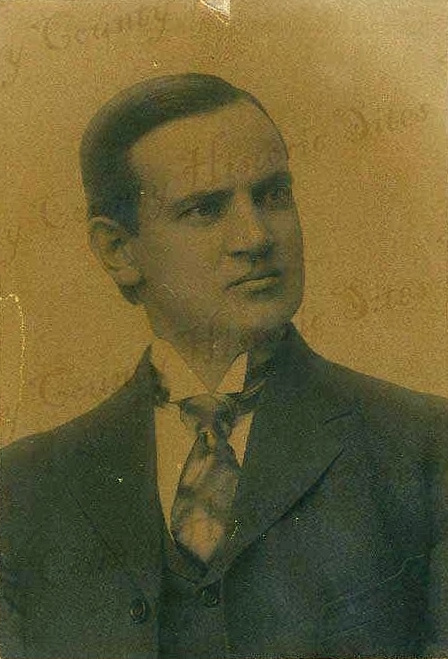
Edwards was actually Jesse Edwards James, son of legendary outlaw Jesse James.
Born in 1875, he was only six years old when his father was shot from behind in the family’s rented house in St. Joseph, Mo., on an April morning in 1882. Already a national celebrity by then, the elder James’ murder catapulted him into American folklore. Among his many crimes, he and his gang were credited with committing the first train holdup near Adair, Iowa, in 1873.
Now his son was being accused of the very same thing.
But the boy was nothing like the dad. He added “Tim” to his middle name, posing as Tim Edwards to conceal his identity as he grew up with his widowed mother and sister in Kansas City. (Although it was an open secret around town who he really was.) He was 23 in 1898, ran a cigar store, and kept a low profile.
The Pinkertons could barely contain their glee. Nabbing the son of the greatest outlaw in American history would make his trial national news. They licked their chops in anticipation of the headlines.
But there was a problem. And it was a big one. Not only did Jesse E. James insist he knew nothing about the crime, but there was also no evidence linking him to it. All the Pinkertons had to go on was one confession.
However, that was enough. The mere public speculation that “another James” was somehow involved looked bad in the court of public opinion. The younger James was arrested in October and charged with complicity in the robbery.
Just as expected, the trial made news from coast to coast when it began in early 1899. Also, as expected, the case against James fell apart almost immediately. The prosecutor had nothing to go on—no evidence, no credible witnesses, not even a motive—just a last name.
Jurors didn’t buy it. James was swiftly acquitted.
“We made up our minds that the police had picked out this boy to railroad him to the penitentiary, and we wouldn’t stand for it,” the foreman said afterward. As for Lowe’s testimony, another juror added, “We believed he was a liar. We simply threw it out.”
One error from news coverage of the trial took on a life of its own. Because of the similarity in their names, the son was incorrectly identified as “Jesse James, Jr.” and is still frequently called that today. But there was no “junior.” The dad was Jesse Woodson James, and the boy was Jesse Edwards James.
At that point, James realized the futility of continuing to use the alias and adopted his real name for the rest of his life. He later became a successful lawyer.
Although in a manner of speaking, he did have a brief criminal career of his own. He played his famous father in two silent movies in the early 1920s.
The father of four daughters, James died quietly in his sleep at age 75 in 1951.