
It started like any other Monday at Long Island’s Belmont Park outside New York City. The weather was warming up as the annual spring horse racing season was winding down, tempting many workers to sneak out of their sweltering Manhattan offices for an afternoon watching the ponies. With temperatures already in the upper 80s and air conditioning still decades away, it didn’t take much temptation.
Horse racing was big in those days, right up there with baseball and boxing. But the thousands of fans who filled Belmont’s massive grandstand on June 4, 1923, saw much more than the usual round of races.
They witnessed something that had never happened before, and hasn’t happened since.
It was a ho-hum race card with largely lackluster entrants that day. Owners entered their best horses in marquee races or ran them on Saturdays, which meant bigger crowds and bigger cash prizes.
Monday races drew the B-Listers, good ponies, but not quite ready for the big time. Still, they did provide the potential for upsets, and you never knew when an unexpected burst of exhilaration might be lurking around the final curve. However, the folks in the stands weren’t expecting excitement; just a few hours of good entertainment.
And they wound up getting much more than they bargained for.
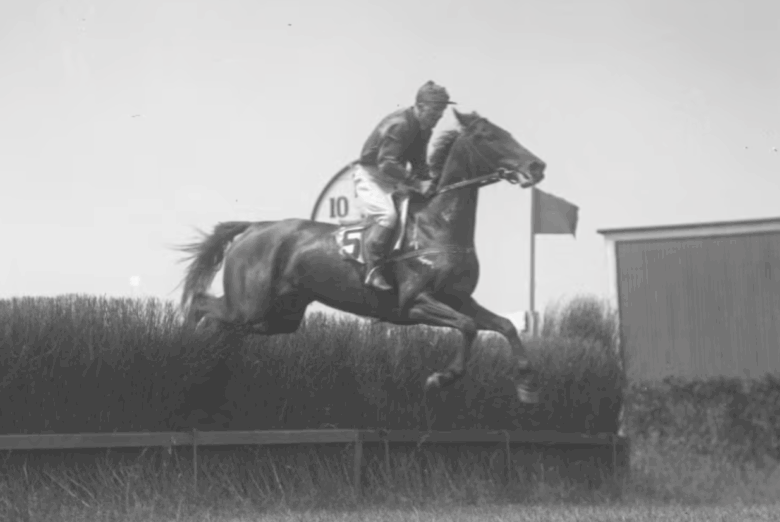
One attraction that afternoon was a steeplechase, an equine obstacle race in which horses jump over fences, shrubs, and ditches. The field included an entrant named Sweet Kiss, described as “a bay mare of obscure background” owned by a Miss A.M. Frayling. A 20-to-1 longshot with a dicey track record, she was nothing to write home about.
Miss Frayling picked an unknown to ride her mare. Frank Hayes was a 22-year-old Irishman who had worked around horses for years as a trainer and stableman. But it seems he had his heart set on becoming a jockey. Some accounts say the steeplechase that day was his very first race; if he had ridden before, he’d never made it to the winner’s circle.
It also seems he’d been on a crash diet to qualify for the ride, too, dropping from 142 pounds to 130 in just days. Which may explain what soon followed.
At any rate, horse and rider were a perfect match: a longshot mare saddled with a jockey nobody had ever heard of. It was a marriage made in “also ran” heaven.
So imagine the immense surprise when Sweet Kiss pulled off an upset, besting the field and winning by a head. The stunned crowd leapt to its feet in thunderous applause. Officials hurried over to congratulate the winning jockey.
Sweet Kiss cantered a hundred yards beyond the finish line.
And then it happened.
Hayes “slipped slowly over his mount’s side, fell face downward, and lay still.” He was dead as a doornail.
At some point during the final quarter mile, he had suffered a fatal heart attack, yet had somehow managed to remain seated.
A horrified silence fell over the crowd. Racing stewards, the final authority who declare the winner of each race, reviewed the situation. They found that since Hayes was still in the saddle when Sweet Kiss had finished, she was the official winner. (Though they did dispense with the traditional post-race jockey weighing, for obvious reasons.)
Hayes finally had his win. He was buried three days later in his racing silks in a Brooklyn cemetery.
The horse racing world also had a new record. No race, before or since, was ever won by a dead jockey.
And what about the mare? The racing community is notoriously superstitious. She quickly acquired the nickname, “The Sweet Kiss of Death.” No jockey was willing to climb aboard her after that, and she never raced again.